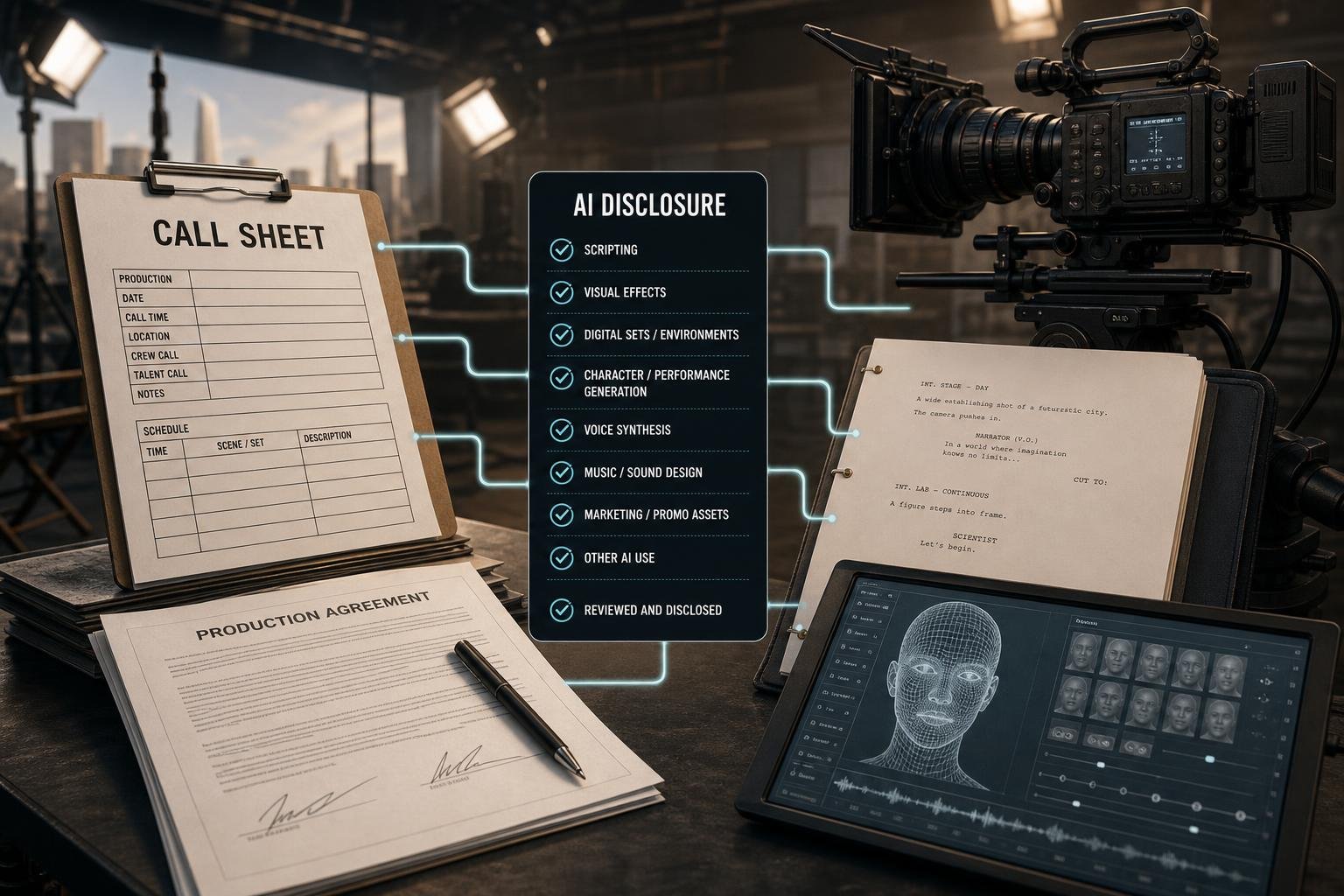
Hollywood’s debate over generative artificial intelligence is often framed as a choice between innovation and human creativity. The actual rules are more specific—and more revealing. Whether a studio must disclose AI use depends on who receives the material, whose likeness or work is involved, and which labor agreement applies.
There is no single rule requiring every film or television production to announce every use of AI to audiences. Instead, writers, actors and directors have negotiated distinct protections governing disclosure, consent and consultation. Those distinctions matter as AI tools enter script development, digital performances and production workflows.
Writers: disclosure begins behind the scenes
Under the Writers Guild of America’s 2023 Minimum Basic Agreement, companies must tell a covered writer when material supplied to that writer was generated by AI or incorporates AI-generated material. The agreement also establishes that AI is not a writer under the contract, and AI-generated material cannot be used as literary or source material to diminish a writer’s contractual rights.
A writer may choose to use AI with the company’s consent and subject to its policies, but a company cannot require that writer to use it. These are workplace protections, not a general requirement that an audience be told when AI helped develop a screenplay. The WGA’s explanation of its AI provisions sets out the distinction.
In 2026, the WGA secured an additional provision: companies must notify the Guild in writing when they license covered writers’ work to train a commercial generative-AI system to create outputs. The Guild may request discussions about such licenses, including remuneration. The 2026 MBA summary confirms that the earlier protections remain in place.
Actors: consent is not the same as a credit
For performers, a central concern is the digital replica—a recreation of a person’s voice or likeness. SAG-AFTRA’s 2023 television and theatrical agreements introduced informed-consent and compensation protections for covered uses of such replicas. A producer generally cannot treat an ordinary contract’s fine print as unlimited permission to reproduce an actor digitally.
As the union explains in its AI resources and contract FAQs, performers must receive information about intended uses, and many uses require additional consent and payment. Rules differ according to the type of replica and circumstances. The union also distinguishes a replica of an identifiable performer from a wholly synthetic character.
These protections are principally about what the producer may do with a performance and how the performer is informed and compensated. Putting an AI acknowledgment in the end credits does not replace the necessary consent.
Directors: consultation over creative choices
The Directors Guild of America’s 2023 agreement took another approach. It affirmed that generative AI is not a person and that duties reserved for DGA-covered workers must remain assigned to people. It also established consultation protections when employers use generative AI in connection with creative elements of a picture.
The DGA’s agreement summary describes those protections and a process for continuing discussions with studios about the technology. Consultation is a labor obligation; it should not be confused with a blanket prohibition on AI-assisted production.
What viewers are told—and what they are not
When a film uses AI-assisted imagery or audio, a public credit or promotional disclosure may help viewers understand how it was made. But a disclosure to a union member, consent from a performer, and an on-screen notice serve different purposes. One cannot automatically substitute for another.
The distinction also matters for reporting. A studio’s use of conventional visual effects should not be casually described as generative AI, and an AI-assisted production should not be labeled entirely AI-generated without evidence. The responsible question is not simply whether a tool was used, but what it created, whose work it affected, and what the governing rules required.
Hollywood’s new question of authorship
The industry’s agreements do not settle every copyright or ethical question surrounding AI. They do, however, reveal what creative workers have insisted on protecting: acknowledgment of their work, control over their likenesses, and a voice in decisions that shape a production.
For audiences, the most useful transparency will be precise rather than theatrical. An explanation of a digitally recreated voice or a synthetic performance says far more than a vague claim that a film was either made “with AI” or “without AI.”
Sources & References
Writers Guild of America — Artificial Intelligence: Know Your Rights. The 2023 agreement’s disclosure and authorship protections.
Writers Guild of America — Summary of the 2026 MBA. Updated provisions on licensing writers’ work for AI training.
SAG-AFTRA — Artificial Intelligence Resources. Performer consent and digital-replica protections.
Directors Guild of America — 2023 Agreement Summary. AI-related consultation and covered duties.