From the archive. Tommy Chong’s 2003 federal case is often remembered as a collision between his cannabis-comedy persona and the drug war. The legal charge, however, was more specific than the shorthand that followed him.
The federal case
Chong pleaded guilty in May 2003 to a federal conspiracy charge involving the sale of drug paraphernalia over the Internet. He also entered a plea on behalf of his family-run business, Nice Dreams Enterprises, which did business as Chong Glass.
The prosecution followed a federal investigation into online paraphernalia sales. In a February 2003 announcement about “Operation Pipe Dreams,” the U.S. Department of Justice said federal agents had targeted sellers and distributors of items the government classified as drug paraphernalia under federal law.
Contemporary Associated Press reporting said undercover agents purchased items connected to Chong’s business and had them shipped to Beaver Falls, Pennsylvania. The case therefore was not a simple marijuana-possession prosecution, and describing it that way would misstate what Chong actually admitted in court.
Sentence and aftermath
In September 2003, a federal judge in Pittsburgh sentenced Chong to nine months in federal prison. He was also fined $20,000, forfeited roughly $100,000, and was ordered to serve a period of supervision after his release, according to Associated Press reporting carried by the Los Angeles Times and CBS News.
Chong later completed the prison sentence and returned to entertainment work. Over time, his prosecution became part of the larger debate over the priorities and symbolism of federal drug enforcement in the early 2000s.
Why the booking image matters
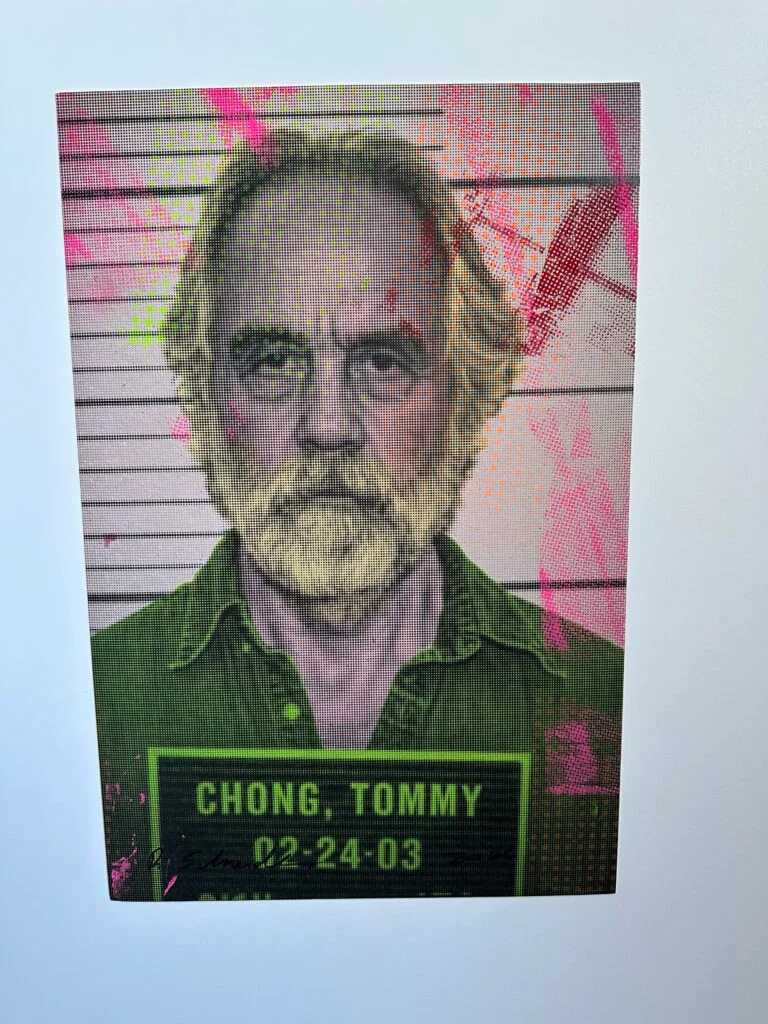
For Hollywood Most Wanted, the photograph attached to the case matters for a different reason. Chong had spent decades performing a highly recognizable countercultural identity. The booking photograph turned that public persona into an official image produced by the criminal-justice system.
That collision is what gives the image its visual force. The viewer already knows the comedian, the films and the cannabis jokes. The mugshot introduces another language entirely: identification, enforcement and institutional authority.
Rachel Schmeidler’s silkscreen treatment pushes the image back toward portraiture. Color, scale and repetition place the official photograph in conversation with Pop Art and with the larger history of artists transforming mass-produced or institutional images into cultural objects.
Arrest record versus public identity
Celebrity mugshots frequently outlive the precise facts of the case that produced them. That is why HMW separates the legal record from the cultural meaning of the photograph. In Chong’s case, the distinction is especially important: the federal conviction concerned a paraphernalia conspiracy, not a simple possession charge.
Read more about the broader visual tradition in How Andy Warhol’s Thirteen Most Wanted Men changed the relationship between mugshots and Pop Art.