
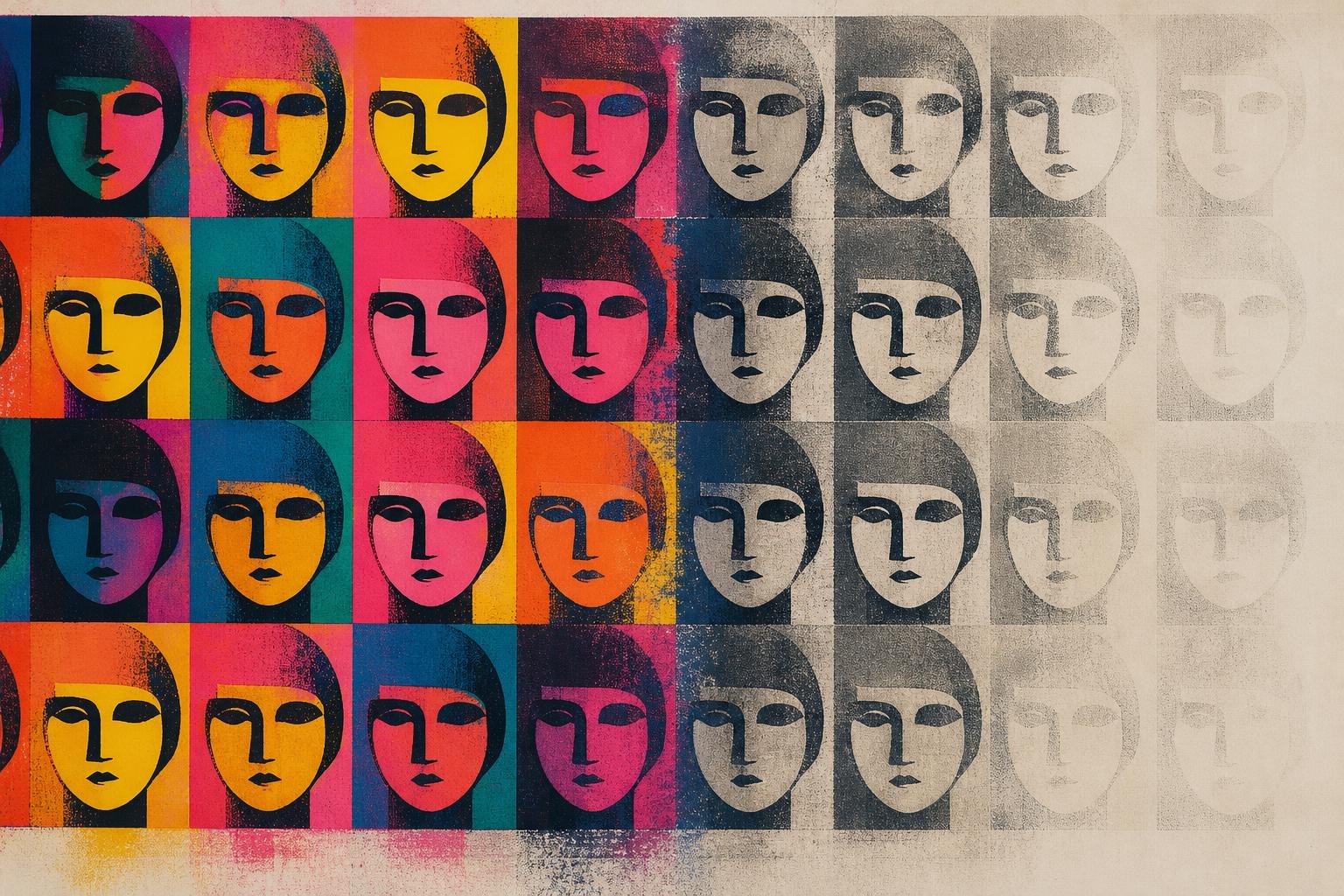
Andy Warhol turned Marilyn Monroe into one of the defining images of Pop Art—not by inventing a new likeness, but by repeating one that Hollywood had already made famous. His 1962 Marilyn Diptych uses fifty impressions of Monroe’s face to explore celebrity, reproduction and the difference between a public image and a person.
Why Marilyn Monroe became Warhol’s defining subject
Warhol made Marilyn Diptych shortly after Monroe’s death in August 1962. Rather than starting with a live sitting, he worked from a promotional image created for her 1953 movie Niagara. The Metropolitan Museum of Art documents Warhol’s use of that publicity photograph in his early Marilyn works.
In the diptych, twenty-five color impressions face twenty-five black-and-white impressions. The colors amplify a star’s carefully manufactured glamour; the monochrome images become increasingly uneven and faint. Those visible changes suggest that an image can be instantly recognizable and still lose detail, certainty and individuality through endless circulation. The contrasting panels also invite interpretations about mortality, although no single reading exhausts the work.
How screenprinting changed the picture
Screenprinting lets an artist reproduce a photographic motif while adjusting ink, colors and registration. Its commercial associations were central to Warhol’s artistic language. The Met notes that the process could repeat images while retaining smudges, gaps and uneven tones.
Warhol returned to Monroe in a 1967 portfolio of ten screenprints, which should not be confused with the 1962 diptych. The Museum of Modern Art explains that the later portfolio reused the publicity photograph with changing palettes and sometimes deliberately off-register color. The same face could feel seductive, mechanical, remote or unsettling depending on how it was printed.
From Hollywood publicity to a lasting pop-art image
Warhol did not simply celebrate fame. He examined the machinery that makes people famous: publicity stills, magazines, television, branding and repetition. Once a portrait can be printed over and over, audiences begin to recognize the symbol before thinking about the human being depicted.
That tension connects Warhol’s Monroe images to Hollywood Most Wanted’s interest in how photography reshapes public identity. Movie-studio portraits and police mugshots serve different purposes and must never be treated as equivalent records. Yet both can circulate beyond their original contexts and acquire meanings their subjects cannot fully control. For a related chapter of Warhol’s engagement with public and institutional imagery, read our feature on Warhol’s Thirteen Most Wanted Men and mugshot art.
Three ways to look more closely at the Marilyn prints
- Look at the source. Begin with the publicity still from Niagara and ask what Hollywood wanted viewers to see.
- Compare the differences. Notice the shifting registration, color, contrast and fading rather than treating the repeated faces as identical.
- Ask what repetition changes. Does the sequence make Monroe more familiar—or does it distance us from her as a person?
Why it matters: Warhol’s Marilyn images remain influential because they make reproduction itself the subject. Each impression reminds us that celebrity images may appear permanent even as their meanings keep changing.
Sources and further reading
- The Metropolitan Museum of Art: Warhol and the Niagara publicity image
- Museum of Modern Art: Marilyn Monroe (1967) screenprint portfolio
- Smarthistory: Andy Warhol, Marilyn Diptych (1962)
Image note: Featured artwork is an HMW editorial illustration, not a photograph of Warhol’s original Marilyn Diptych or an authorized reproduction of the artwork.