
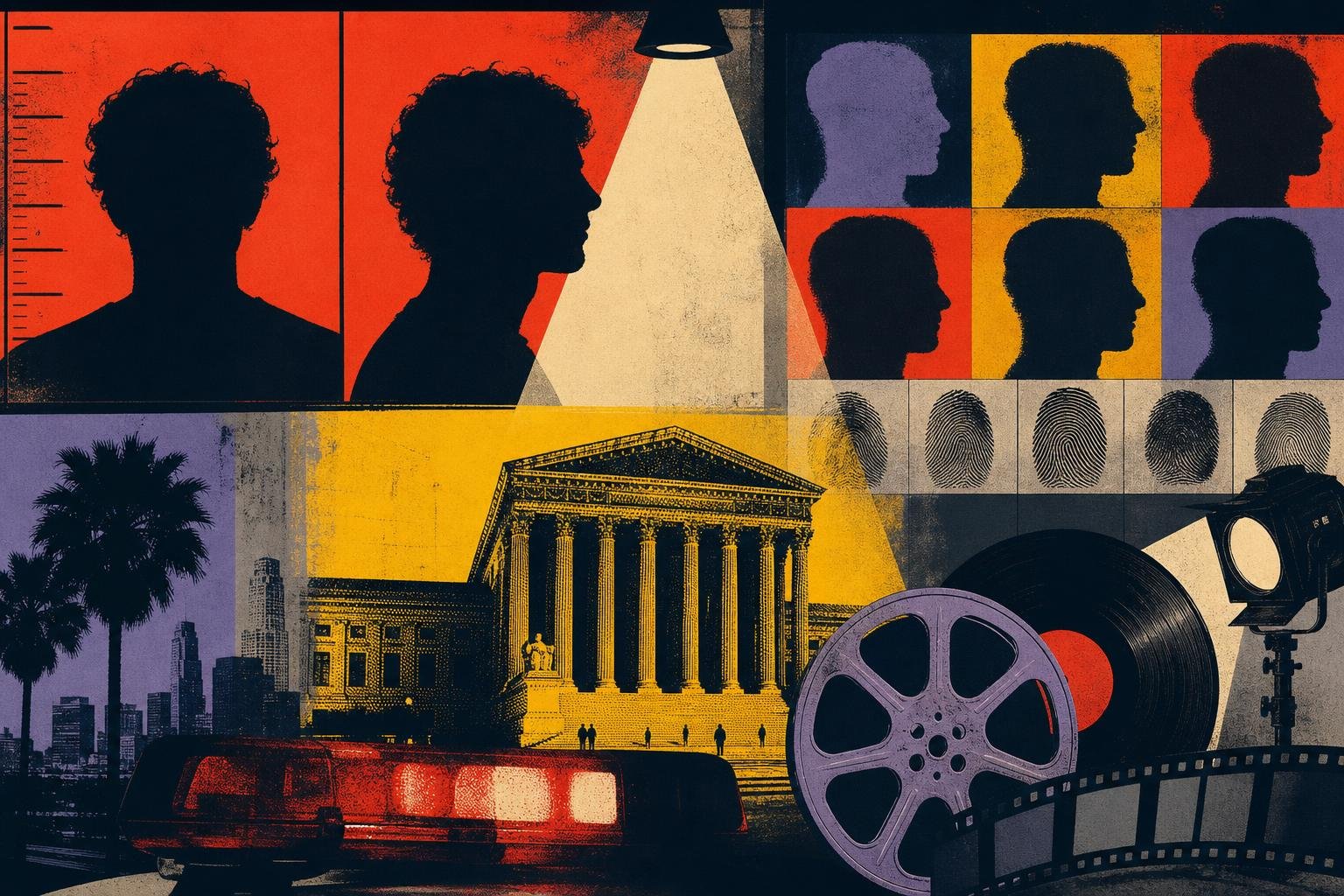
Celebrity mugshots became pop art because they compress fame, authority and vulnerability into one standardized image. Andy Warhol made that tension explicit in 1964, when he enlarged police photographs for Thirteen Most Wanted Men, transforming administrative records into a provocative public artwork—and establishing a visual formula Hollywood still uses.
How police photography acquired cultural power
The booking photograph was designed for identification, not entertainment. Its frontal pose, flat lighting and institutional background remove the styling that normally protects a star’s image. When the subject is famous, that visual austerity collides with a carefully managed public persona.
Warhol understood that collision. His New York State Pavilion mural for the 1964 World’s Fair reproduced images from a police booklet before the panels were covered with silver paint. The project connected surveillance, celebrity and mechanical reproduction—central concerns of Pop Art. Editors should verify details against museum collection records and surviving World’s Fair documentation before publication.
A brief visual timeline
- Late 19th century: Alphonse Bertillon’s identification system helped standardize frontal and profile police portraits.
- 1964: Warhol converted police imagery into monumental public art through Thirteen Most Wanted Men.
- 1994: Controversy over the altered Time cover using O.J. Simpson’s booking image demonstrated how editorial treatment can change racial and emotional meaning. Simpson was later acquitted in the criminal trial.
Why the celebrity mugshot became Hollywood shorthand
A mugshot appears to offer unfiltered access, but it remains an image produced by the state under controlled conditions. Entertainment media nevertheless uses its familiar codes—direct gaze, identification board, blank wall and hard flash—to signal scandal, downfall or rebellion.
Fashion shoots, album covers and film marketing often borrow those codes without reproducing an actual record. This distinction matters: an authentic booking photograph documents an arrest, while a staged portrait merely adopts its visual grammar. Neither establishes guilt. Captions must separate arrest, charge, conviction, dismissal and acquittal.
Risks, mistakes and recovery
The most damaging mistake is treating arrest as proof of guilt. Other risks include misidentification, outdated case information, unexplained image manipulation and using humiliation as decoration. A disclaimer cannot repair a misleading headline or caption.
If an error is discovered, remove questionable artwork while you verify it, correct the legal status prominently and retain a transparent correction note. For exhibitions or branded campaigns, document the source, license, edits and curatorial purpose before release. That record helps decision makers assess both legal exposure and cultural context.