For a performer who built a career out of turning chaos into spectacle, the booking photograph becomes another strange chapter in the construction of a public image.
Steve-O, born Stephen Glover, became widely known through Jackass, where danger, embarrassment, pain and performance were part of the material itself. His official biography traces the path from clown school and stunt videos to Jackass, books, stand-up comedy, YouTube and the Wild Ride with Steve-O podcast.
That history makes his booking photograph particularly interesting.
In 2002, Steve-O was booked in Louisiana on obscenity and accessory-to-battery charges connected to a nightclub performance. Contemporary coverage described allegations arising from events during the performance. The image has survived far beyond the immediate legal episode that produced it.
Turning the booking image into art
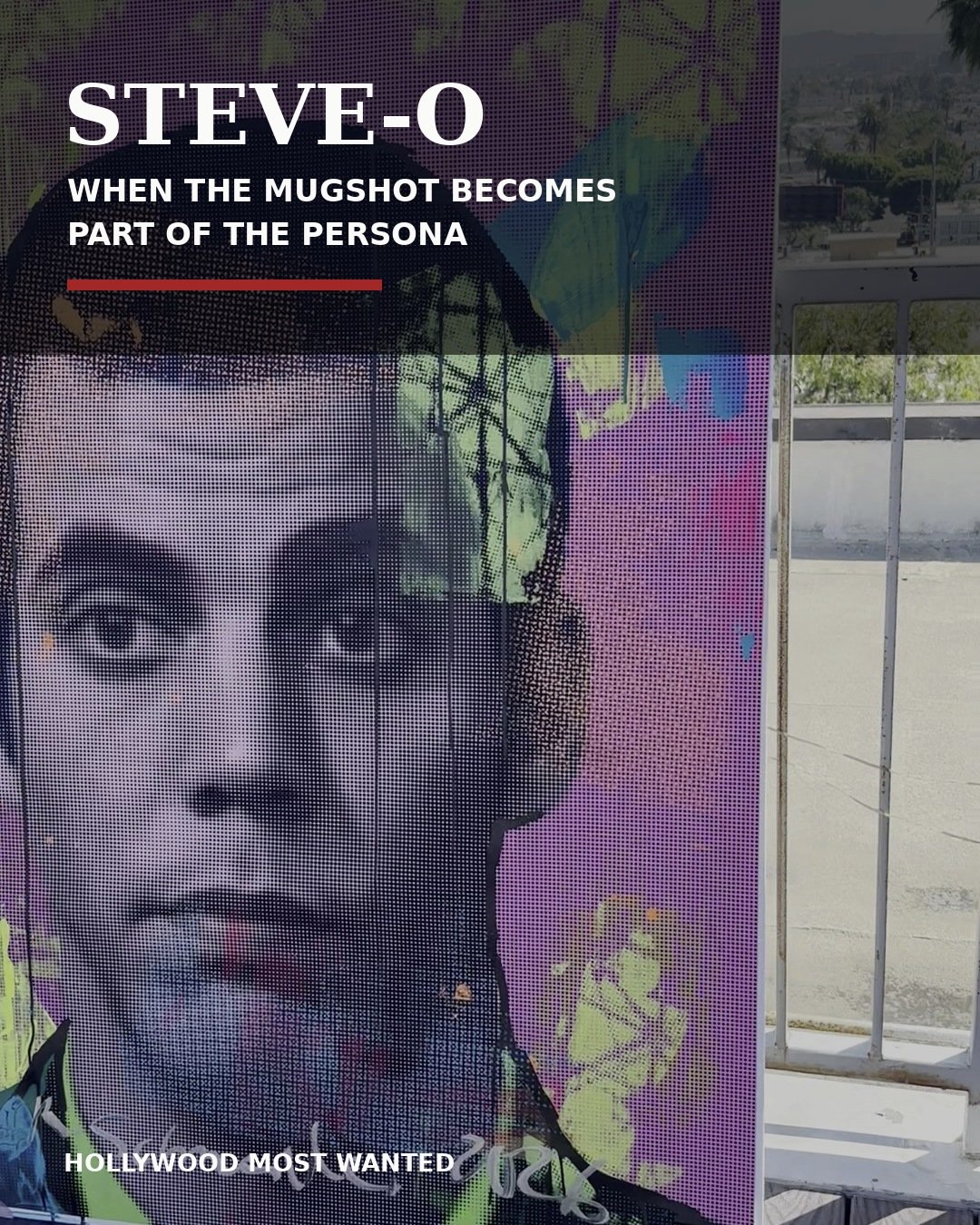
Rachel Schmeidler has worked with celebrity mugshot imagery for roughly two decades, enlarging and recontextualizing booking photographs as physical artworks.
The Steve-O portrait fits naturally within that body of work because his career has always had a complicated relationship with documentation. Cameras did not merely record what he was doing; the presence of the camera was often part of the performance.
A booking photograph reverses that relationship. The subject does not direct the spectacle, control the framing or choose the edit. The image belongs to another system entirely.
When the photograph is transformed into an artwork, it moves again: from institutional record to media artifact to portrait.
When does a mugshot stop functioning primarily as evidence of an arrest and start functioning as part of a celebrity’s visual identity?
The image changes when the person changes
Steve-O’s later public story extends well beyond the behavior that first made him famous. His official materials foreground his stand-up career, books, podcast, online video work and sobriety. His later writing has also addressed aging, maturity and living with the consequences of a life built around extreme experiences.
That changes the way an old photograph reads.
The booking image has not changed. The person and the surrounding story have.
That is one reason celebrity mugshots remain culturally potent: their meaning is not completely fixed at the moment the shutter closes. What follows can make the image look tragic, absurd, insignificant, prophetic or disconnected from the person the subject eventually becomes.
From the rooftop
Photographing and filming the Steve-O artwork against the Los Angeles skyline adds another layer to that transformation.
The original image belongs to a booking process in Louisiana. The artwork now exists above West Hollywood, inside a studio environment looking out over a city closely associated with the machinery of celebrity image-making.
That movement — booking photograph to artwork to Los Angeles skyline — captures the central idea of Hollywood Most Wanted.
The subject is not simply crime.
It is what culture does with the image afterward.
The booking photograph is only one frame in a much longer public story. And perhaps that is exactly why it is worth looking at again.
Artwork: Steve-O Mugshot Artwork
Artist: Rachel Schmeidler
Series: Hollywood Most Wanted