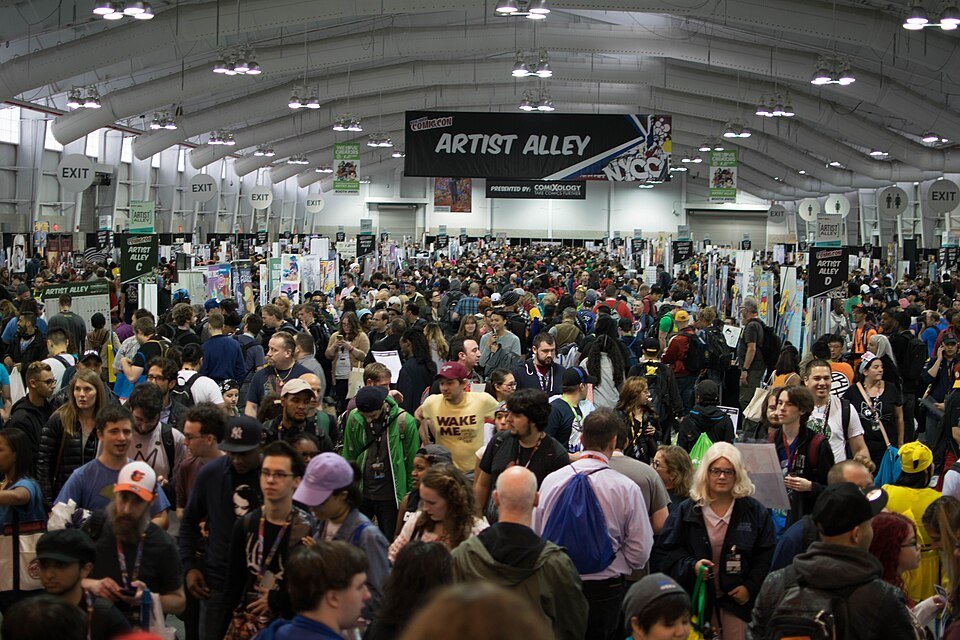
At an Artist Alley table, a buyer can ask a question that an online image rarely answers on its own: how was this made? At L.A. Comic Con 2026, that conversation has a written policy behind it.
The convention’s Artist Alley AI policy prohibits displaying or selling materials created wholly or in significant part with generative artificial intelligence. It covers artwork, prints, merchandise and other materials, with examples including generated images, illustrations, graphics and animation.
The rule makes creative authorship a condition of participation in a specific marketplace. Its significance reaches beyond whether a finished print looks convincing: it concerns what visitors are being invited to support when they buy directly from a creator.
What the L.A. Comic Con policy actually says
The published policy requires materials at Artist Alley tables to reflect the exhibitor’s own creative authorship. It says an artist found in violation may receive one warning and must immediately remove noncompliant materials. A second violation may lead to removal from the event without a refund.
Its stated scope is Artist Alley tables. That wording does not establish a blanket rule for every technology demonstration, sponsor activation or other activity across the convention. The page also does not provide a numerical threshold for what counts as a significant AI contribution.
The page does not report enforcement outcomes. Its generative-AI restriction should not be described as a ban on digital drawing.
A wider convention-marketplace question
L.A. Comic Con is part of a broader conversation among event organizers. Anime NYC’s Artist Alley rules also prohibit AI-generated artwork. Rose City Comic Con’s application rules combine an AI prohibition with requirements about creators appearing at their tables and restrictions on reproducing other people’s art.
Those policies have different wording and should be read separately. Together, however, they show why authorship has become a practical issue for convention organizers: an Artist Alley is a selected group of sellers, with limited space and a promise about the kind of work visitors will encounter.
Our analysis is that the process behind an image becomes part of the product’s identity in this setting. Someone buying a print may be buying access to a particular artist’s decisions, experience and developing body of work, as well as a picture they enjoy.
An event rule and copyright answer different questions
A convention’s eligibility policy should also be distinguished from copyright law. In its January 2025 report announcement, the U.S. Copyright Office explained that copyright can protect sufficient human expression in work involving AI. It also said that merely providing prompts does not supply the necessary authorship, while using AI as an assistive tool does not automatically disqualify a work.
That framework concerns legal protection for human expression. L.A. Comic Con’s policy concerns what may be displayed and sold at its Artist Alley tables. Neither question substitutes for the other, and a marketplace restriction alone does not establish that a particular work infringes copyright.
For buyers, start with the artist’s process
The most useful questions are specific and open-ended:
- What did the first sketch look like?
- Which parts were drawn, painted, modeled or assembled?
- Is this an original, a reproduction or a commissioned piece?
- Who else contributed?
These questions make room for collaboration and digital craftsmanship without treating an unusual-looking image as evidence of wrongdoing. A buyer can learn something about the work; an artist can explain choices that disappear in a thumbnail. Questions about compliance belong with event staff rather than public accusations based on appearance.
Follow the work beyond the weekend
Concrete examples are more revealing than an abstract argument about whether images have value. Livio Ramondelli’s creator-owned robot stories connect illustration to writing and world-building. Fanbase Press’s catalog connects genre storytelling to illness, language and identity.
Artist Alley gives visitors a chance to ask how those connections were made. Whatever a buyer spends, leaving with the creator’s name and a route back to their work makes that exchange more useful than a passing encounter with an image.