
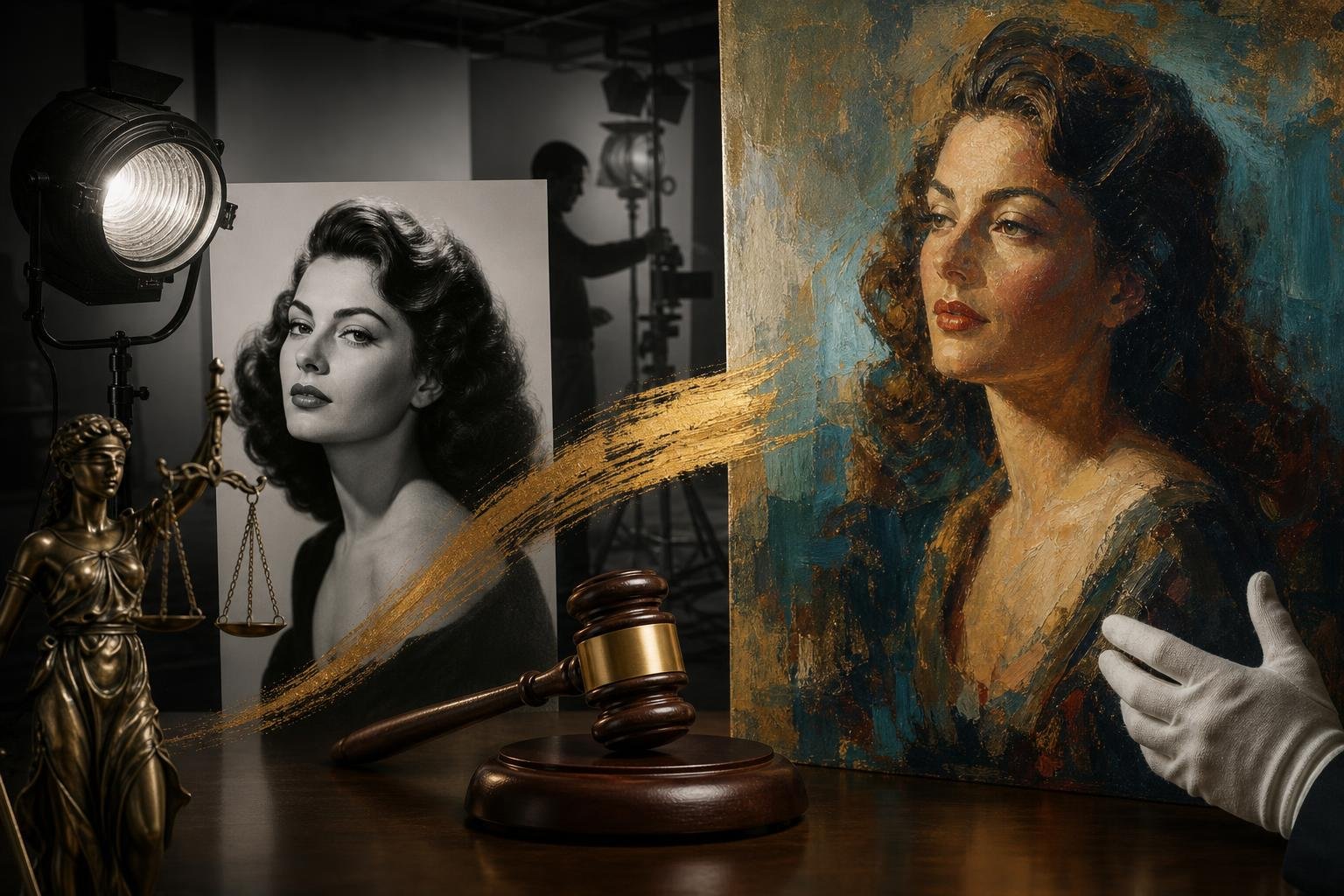
Hollywood has always understood the power of a face.
Long before Instagram and digital retouching, movie studios carefully constructed the public images of their stars. Lighting, wardrobe, expression, and composition helped create portraits audiences would recognize instantly.
These photographs promoted films and manufactured stardom. But when an artist takes a Hollywood publicity portrait out of its original context, the image can begin to tell a different story.
When a Photograph Becomes an Icon
Hollywood publicity photography occupies a space between portraiture and advertising. Its purpose was often to circulate a recognizable public identity, even when the image appeared intimate.
Through painting, collage, screen printing, or large-scale reproduction, artists can challenge the mythology those photographs were created to support. A promotional portrait becomes an opportunity to examine fame, beauty, and celebrity culture.
Andy Warhol and the Reproduction of Fame
In 1962, following Marilyn Monroe’s death, Andy Warhol created Marilyn Diptych, repeating her image across fifty panels. The source was a publicity photograph associated with Monroe’s 1953 film Niagara.
Through repetition, color, and mechanical reproduction, Warhol made a familiar Hollywood face simultaneously glamorous and unsettling. The repeated image evokes both the power of celebrity and the vulnerability of the person behind it. Smarthistory’s discussion of Marilyn Diptych examines this relationship between repetition and celebrity.
The Artist’s Interpretation
Transforming a celebrity photograph into fine art involves more than changing its colors or enlarging its dimensions. Composition, scale, texture, repetition, and context can alter what viewers understand about an image.
A monumental portrait may confront viewers with the manufactured perfection of celebrity. A fragmented image may question the relationship between public recognition and personal identity.
Publicity photography is designed to control an image. Art can challenge that control.
The Question of Copyright
Artistic reinterpretation can also raise copyright questions. In 2023, the United States Supreme Court considered commercial licensing of an Andy Warhol image derived from photographer Lynn Goldsmith’s portrait of Prince.
In Andy Warhol Foundation for the Visual Arts, Inc. v. Goldsmith, the Court rejected the Foundation’s fair-use argument concerning the specific licensing use before it. The decision did not hold that every artistic reinterpretation of a photograph infringes copyright; the purpose and character of the particular use matter.
Hollywood’s Faces, Reimagined
Hollywood creates images intended to be remembered. Fine art can transform those images into questions about who creates fame, who controls identity, and why certain faces become fixtures of popular culture.
The transition from publicity portrait to artwork is not simply a change in medium. It is a change in meaning. The photograph no longer exists only to promote the star; it can examine the culture that made the star famous.
Sources & References
Smarthistory — Andy Warhol, Marilyn Diptych. Art-historical discussion of Warhol’s 1962 work and its celebrity imagery.
Supreme Court of the United States — Andy Warhol Foundation v. Goldsmith (2023). Primary legal source addressing fair use and commercial licensing.