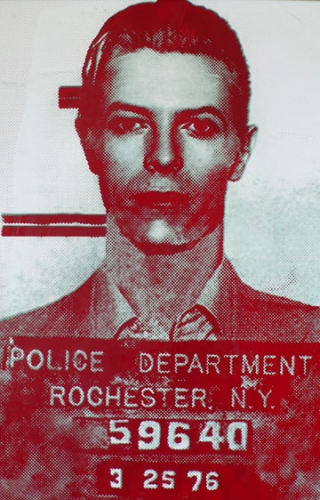
David Bowie’s 1976 Rochester mugshot has become one of the most reproduced images of his career. It is also a reminder of how much context a booking photograph can leave out.
Bowie was arrested in Rochester, New York, in March 1976 following a concert at the Community War Memorial. Police charged him, Iggy Pop, and two other people with felony marijuana possession after an incident at the Americana Rochester Hotel. Bowie was released on bail and continued his tour.
The image most people now recognize as the “Bowie mugshot” was not taken at the moment of the arrest. It was made several days later when Bowie returned to Rochester City Court for arraignment. Wearing a suit and looking directly into the camera, he produced a booking image that would eventually become almost as iconic as many of his carefully constructed album portraits.
The Arrest and the Case
At arraignment, Bowie pleaded not guilty. Contemporary accounts describe a crowded courthouse filled with police, reporters and fans. The charge was serious under New York law at the time, but the case did not end in a conviction. A grand jury later declined to indict Bowie and the charges were dismissed.
That distinction matters. A mugshot records contact with the criminal-justice system; it does not, by itself, establish guilt. In Bowie’s case, the image survived and circulated long after the prosecution ended.
When a Police Photograph Becomes Pop Culture
The photograph is striking because it does not look like the chaotic image many people associate with a celebrity arrest. Bowie appears composed, almost formal. The result feels less like an administrative police record and more like an accidental portrait from the Thin White Duke period.
That transformation—from official record to cultural artifact—is central to the Hollywood Most Wanted archive. Celebrity mugshots often begin as institutional photographs, then take on entirely different meanings as they are reproduced, collected, reinterpreted and turned into art.
Rachel Schmeidler’s Hollywood Most Wanted project has long explored that collision between fame, accusation, public memory and image-making. Bowie is an especially clear example: the arrest became a footnote, but the photograph became part of the iconography.
From Mugshot to Archive
Bowie’s Rochester image also fits a larger HMW question: what happens when a photograph created to document an arrest becomes more culturally durable than the legal case surrounding it?
The answer is visible in the archive. The mugshot can be read as police evidence, celebrity memorabilia, rock-and-roll history, a fashion image, or source material for contemporary art. Each reading changes the meaning of the same photograph.
For Hollywood Most Wanted, the goal is not to flatten that history into a “celebrity busted” headline. It is to restore the context around the image—and then examine why the image endured. That same approach runs through HMW’s Jimi Hendrix archive story and the broader look back at Rachel Schmeidler’s earlier HMW archive writing.
Sources & References
- The Smoking Gun — David Bowie mug shot and arrest details
- David Bowie official site — Rochester police mugshot history
- The Week — Rochester arraignment and case outcome
Featured image: